

As we take off on our journey to seeking to understand the value in providing appropriate accommodation for our diverse learners, it’s important to recognize a few things.
First, if you are a teacher, educational leader, parent of a neurotypical or neurodiverse child, this experience is for you. You want to best understand how to support the youth that you lead.
Secondly, supporting the neurodiversity in the nervous system needs of the little humans that you lead is not as complex as it sounds. It’s valuable, especially when done right. (And you CAN do it right).
Lastly, mental health is at the center of so many more conversations than the past. Let’s celebrate this. Yet, let’s not ‘fluff’ or ‘bandaid’ mental health challenges. Let’s get to the roots. Starting here. By understanding our sensory and nervous systems so we can understand, unfold, and undo the impact it has on our behavior, decisions, and relationships.
Yet, before we go into the conversation about the tools used for regulation, lets start with a foundational understanding- We all have a nervous system- therefore we all have nervous system needs. These needs vary due to prior experience, daily circumstances, trusting relationships, and basic needs being met. Because of this, its crucial to develop awareness, language and supports based on our sensory and nervous system needs.
Therefore, starting today, I take you on a journey of exploration to consider effective accommodations for nervous system needs. You will understand how to support self regulation, behavior response and mental health of not only the youth you lead, but yourself as well. You will have less conflict and effectively respond to challenging behavior

Putting on “Sensory Lens”
After spending a couple days with my sensory lens on- I realized how much I navigate my life using my senses as a radar in creating safety and support for my family. By understanding how my senses program my nervous system response (aka behavior), I’m able to identify the cause and effect relationship. In doing so, I recognize the source of regulation is through my nervous system and my nervous system is getting information through my sensory organs.
Which leads us to the purpose of this series: Get to know our sensory systems’ function and how it effects our behavior response so we support nervous system needs with effective accommodations.
Nervous System and Sensory System Relationship
Again, getting to know how our sensory system communicates with our nervous system is vital to creating behavior change.
Definition:
Let’s define the relationship between our nervous system and sensory system. In this, we will discover
- The sensory nervous system carries signals from various receptors (sense organs and simple sensory nerve endings) to the central nervous system (CNS). This pathway informs the central nervous system (the brain and the spinal cord) of stimuli within and around the body.
Considering this, your sensory system composed of your sensory organs (ears, nose, mouth, eyes, skin) are the inputs to the central nervous system. Our central nervous system is then sending messages of action for our body and brain to release certain chemicals to create action and reaction.
In this basic definition, it creates the clarity of the value of getting to know what we are processing though sensory input and if the message is creating a stress response in our central nervous system, how important it is to utilize our senses for reset and regulation. Therefore, we will be using your senses to explore interventions and accommodations through this series because truly- it is the starting point to the cause and effect of behavior.
Some Basic Management Tips
With the title “It’s not entitlement, its effective accommodation,” I want to ensure that we have a shared understanding. A sensory tool is only effective if it’s managed and utilized intentionally. Therefore, I hold these parameters when introducing them to my students, self and child.
- It’s a tool, not a toy. The moment you recognize that you feel regulated and ready to return, listen to your nervous system, and return.
- If your nervous system is not returning to regulation with that tool, utilize another sensory system tool for support. For example, if your using an auditory tool (noise cancelling headphones) and you still feel your heart rate and breathing as high, try a tactile tool (a squishy ball).
- Sensory Tools are not meant to distract you from your learning or doing. It’s to support you become regulated and ready to ‘get to your cortex.’ Becoming self-aware of time needed for regulation is important. It’s important to remember the purpose behind the practice. I teach self awareness through this, yet I am also aware of the behavior when engaging in using sensory tools. I provide feedback and support in efforts to develop self-management and self-regulation.
Auditory Sensory System
Starting now, let’s explore our essential question around the Auditory Sensory System: How does audio processing impact your behavior response?
Definition:
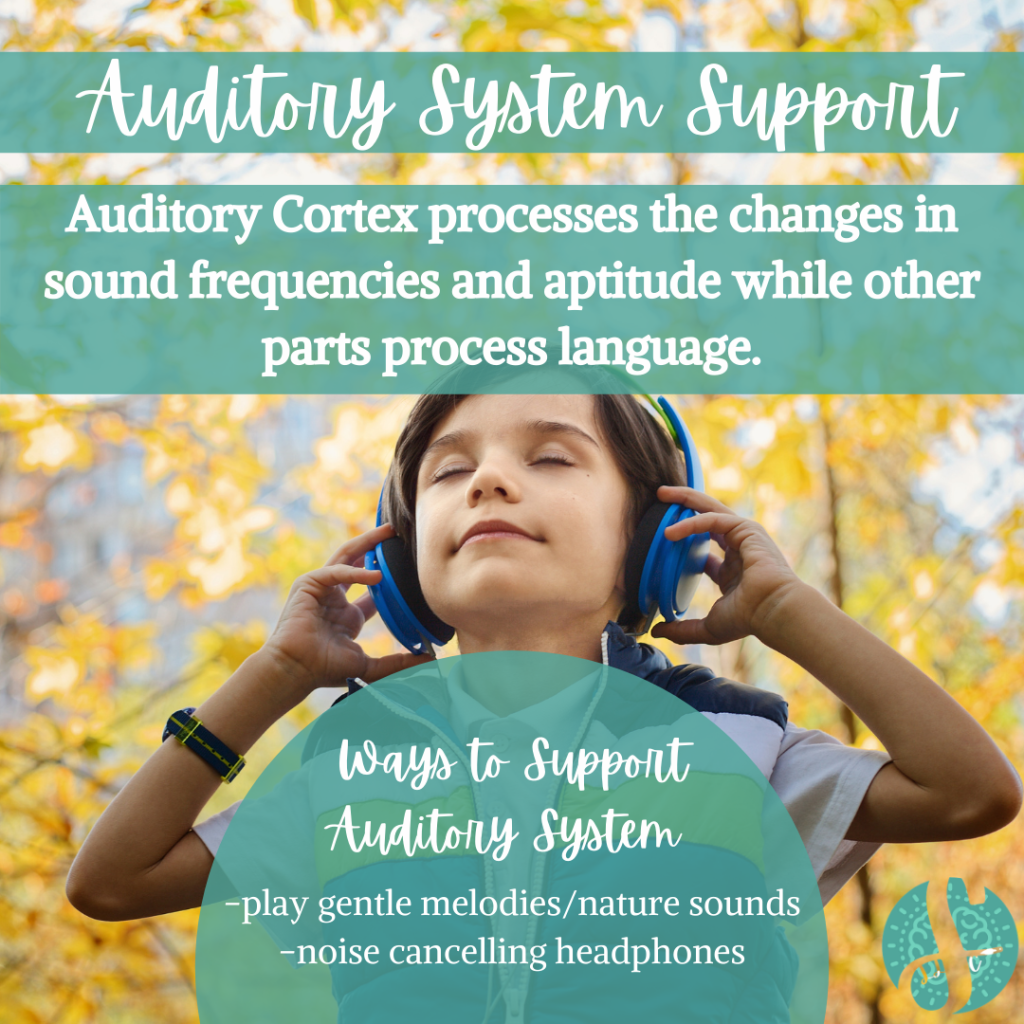
Auditory Cortex processes the changes in sound frequencies and aptitude while other parts process language. Therefore, our auditory system is focused more on the speed, tone, voice level BEFORE processing language.
As a teacher and as a parent and partner, it’s important to recognize that our brain is interpreting these things before anything I say. Again, a necessary understanding in supporting our students get to their cortex (and our teaching to ACTUALLY be listened to and process as learning).
Facts:
- Ninety percent of a growing child’s knowledge is attributable to listening to background conversation. Therefore there is value in being aware of what you are saying AROUND them, not just TO them
- What we hear, what we see and what we smell is absorbed the same way- through energy. Being aware of the energy absorbed can help us understand effective support to regulation.
Anecdotal:
My beautiful daughter has sensory processing dysfunction. When it comes to sensory input, she is either overstimulated or understimulated and her behavior demonstrates the over or underwhelm that she is experiencing. By understanding that her behavior is communicating a sensory over or underwhelm, it helps me better respond and be proactive in communication and support. Through this, our relationship and communication has been strengthened through sensory awareness and understanding.
As this series started with taking note of observations with my sensory lens on, let me share with you some noticings. This will further us into sharing what ‘effective accommodation’ looks like versus entitlement.
First, I had a dear friend remind me a very important thing when it comes to communication and it connects to our auditory system: Don’t let the mess, mess with the message. In other words, amplifying your voice (yelling, ect) actually interferes with the communication of WHAT you are saying because your nervous system received the voice LEVEL and is actively determining if the message will be safe or friendly and in processing, misses the message itself! So, low voice and slower speed actually helps our brains receive the message (not the mess).
Next, through awareness, we can process less than expected sounds. For example, when my daughter is activated by an unexpected, loud or unfamiliar sound, she gets overwhelmed and shuts down. I’ll never forget the first time she heard a hand dryer. She demonstrated a sensory meltdown and covered her ears and screamed (to have control over sound input) and essentially had a nervous system response.
With this, we have to be more aware of our environment and be prepared for unexpected sounds and behavior response. We have also taught our daughter to have self-awareness as well and communicate when she can. If the TV is too loud or if the environment she’s in is creating overwhelm, she can ask for a sensory or sound break (leave the room, put on headphones, etc.). Because of the support from her OT, research on sensory processing and loving support, she has grown in communication, adaptation and resiliency.
As a teacher, these tokens of practice have been monumental in supporting children in the classroom environment. When a child is challenged with the announcements on the speaker, I no longer corrected them for ‘not listening’ when putting their head down and covering their ears. I now ask them targeted questions: Are the announcements too loud for you? Is the sounds of the learning challenging for you? Which lead me to appropriate accommodation and support.
Application:
When a student or child is experiencing either a sense of overwhelm or underwhelm when it comes to auditory processing, the accommodation is appropriate based on if they need more or less auditory input.
| Auditory Underwhelm (need more input for regulation) | Auditory Overwhelm (need less input for regulation) |
| Calm and Nature Music (either in headphones or whole class environment) Create sound in a non-distracting space (be able to sing / talk loudly in a non-distracting space) | Noise cancelling headphones Quiet/silent workspace (this accommodation is most for those with auditory overwhelm) |
Keeping the above in mind, it is CRITICAL to remember that the tool for accommodation must align with the sensory need. If a student is seeking auditory input (because their not getting enough) and demonstrating the need through yelling, tapping and humming, providing noise cancelling headphones would amplify the need, not support it. Therefore its equally important to understand what behavior is communicating: need for more input or less input. On this journey, you will begin to understand the difference between the two.
Wrap-Up
If you are an educator and would like to apply your understanding of sensory processing in your classroom environment and experience, subscribe below for impactful resources.
Your students and self will be more reflective, regulated and connected. You will develop authentic community and communication and experience sensational synergy in your classroom and school community.
References and Resources:


 Sensational Synergy