These are words you say when you are physically, emotionally or socially exhausted. You have limited capacity to contribute.
I’ve said this myself and have most definitely have heard it amongst my peers. Overwhelm. Fatigue. Burnout. The reality of servant leadership is when you spend your energy caring for others, it often leads to physical, emotional or mental fatigue. The degree upon which you feel this fatigue is based on frequency and duration of the support you provide as well as receive. Therefore, its incredibly important to stay connected with others and honest in our self-reflection of our well-being.
With this, I was having a great conversation with a great friend and mentor of mine. When we were debriefing about the heightened stress in teachers and students, she re-explained the “flipped lid” theory from Daniel Siegel. Let me explain this reimagined model.
Make a fist with your hand by putting your thumb in your palm and closing your fingers over your thumb
Move your fingers up in the fist so your fingers are only bent at second knuckle (barely covering your thumb but still a closed fist)
This now represents a modified “hand model” of the brain where the amygdala(represented by the thumb) is more exposed and less protected by our cortex (represented by our fingers).
When your stress response is active, similar to the modified ‘hand model,’ it doesn’t take much stimulus for your stress response to activate. A pencil drop, an unexpected sound or situation, your nervous system goes into fight, flight or freeze automated response.
With this, I want you to notice something.. do you find yourself ‘managing’ your ‘bandwidth’ until it’s fried or burnt out? A lot of us do. And this ‘bandwidth management’ is clearly or invisibly impacting our health and relationships. And this is why it is so incredibly important for you to understand our nervous system so you can be more attune to body signals when managing your ‘bandwidth.’
Let’s be honest. We’ve been recovering from collective community trauma (aka world pandemic and more), so our ‘bandwidth’ has been constricted and our stress response system has been highly active. Therefore, your nervous system has been in overdrive on a daily basis. Again, another reason why it’s important for you to understand healthy ways to manage your bandwidth.
So, what should you do? How can you balance your daily energy withdrawls?
Let me provide some short and sweet suggestions (as time is a deposit AND a withdrawl):
Sensation Self -Check: Are you feeling tense? Are you feeling tired? Are you feeling cold? These body signals are indicators that your nervous system is actively managing your stress and is signaling a slow down for your mind and body. You don’t need to do anything drastic to pause- simply stop and reconnect with your body through breath and grounding techniques.
Name it to Tame it: No need to go tell someone, but if you have a safe person- you can go to them to share your ‘bandwidth’ support need. Yet, you can also use self-talk and tell yourself to pause and tell yourself “my bandwidth needs some support, so I could… (insert strategy here).”
Distract your energy with a low-level or engaging task: Turn on music, go to the bathroom, tidy up your desk, go for a mini-walk. Something that takes little to no cognitive energy. This will give you a mini boost to your bandwidth. When you can take 90 seconds- 2 minutes to shift and settle your energy use, it provides you enough endorphins to reset and return to the more demanding tasks of your day.
When you take care of your emotional, cognitive and relational energy, you will find yourself responding more effectively in stressful situations. You’re working from the reasoning part of your brain (cortex) rather than your fight or flight (amygdala) part of your brain.
With this, I want to encourage you to not feel the pressure of having to do a lifestyle change in order to restore your bandwidth. It truly is a mini-moment investment and awareness of restorative experiences. Taking the two minutes to disconnect from a stressful circumstance can empower you far more than you expect. You manage stress to varying levels throughout your day. May you find the moments to restore your bandwidth to build your capacity to do all of the great things you can do!
“Synergy – the bonus that is achieved when things work together harmoniously.” – Mark Twain
As a parent, I always want the best for my child. She’s my one and only. In her first decade of life, I have learned more about myself through her. She’s opened my eyes to many things I never saw in myself.
She’s shown me that I can be courageous while also being cautious. I can be strong, while also being sensitive. She has empowered me to embrace my true self and in this authenticity, I believe in our capacity to do great things, even when they aren’t easy.
Now, for a little bit of “Title” tossing-out. My daughter and I have both been officially diagnosed with Generalized Anxiety Disorder. With this, we are able to support each other’s challenges with compassion and connection. Yet, that doesn’t mean it’s easier because of empathy. Our emotions and stress can still get in the way of our daily functioning, but we can support each other without judgement.
Secondarily, through my own personal journey, I have discovered that I am an Enneagram 9 and most definitely considered a “Highly Sensitive Person.” Yes, that means that I have a big heart and care about others, yet it’s also a genuine physical and emotional experience for me. I feel more deeply and experience life more richly.
Lastly, my sweet daughter has challenges with Sensory Processing Integration. What this means is that her brain has a difficult time processing the sensory information it receives which can create heightened physical and emotional responses. In other words, her brain in uniquely designed to deeply experience her daily life.
Generalized Anxiety (GAD). Highly Sensitive (HSP). Sensory Processing Integration( SPiD). These terms or labels are not deficits, they are strengths and will continue to build resiliency through connection and reflection.
With this, I had an experience that helped me realize that not everyone has this ‘feel deeply’ experience.
I’d like to provide this scenario to help generate some truths behind navigating parental challenges. Again, my daughter has a beautifully designed nervous system that leads her to embracing life deeply. She is courageous and brave while also timid and tense. Therefore, when conflict arises, she can sometimes react bigger than expected.
For example, when she felt her friends weren’t listening, she told them that she “hated them.” Which then led to responses like “you’re overreacting” and “you’re mean.” Developmentally, this is a ‘sometimes expected’ response. Pre-teens are navigating how to best express themselves emotionally and most often its more intense than they even expect it to be.
This is where the unique awareness for myself as a parent came in. When I read about this interaction (virtual exchange between school friends), I recognized the somatic experience it gave me. I felt those tingles and numbness that you’d feel when someone said or did something hurtful. It was interestingly an empathetic physical response. I felt as if the words were spoken to me. And this is where I am grateful for my awareness that can lead me to a rational response.
My nervous system response led me to an emotional response of sadness and a physical reaction of numbness and wide-awake-ness. Oh did I mention it’s 1:30 am as I write this? Probably not because I know I should be sleeping yet my emotional processing has me physically wide awake.
Going back to the scenario, I ask myself, How can I support my child through validation (of her big feels), reflection and restoration?
I have learned what I shouldn’t and won’t do- have an immediate response of anger, punishment and shaming behaviors. Unfortunately this is the typical-ish response in parenting- respond with intensity to eliminate behavior. By doing this, it simply invalidates emotional and social development and shuts down the ability to grow through the hardship.
Do I believe in accountability- you betcha. Yet how the accountability is communicated is the key element in this scenario, I mindfully choose my language and best frame my reflection questions with curiosity not shame. The “tell me more” request remains the most powerful statement. When I am able to validate the feelings she’s sharing with me, it also creates a safety that builds her resiliency as well as self-compassion.
By investing my energy into seeking to understand, it encourages my daughter (and others) to re-evaluate the situation and be able to become more collaborative in problem solving. Now because of this, I am hopeful that when scenarios arise such as the one shared above, I will be able to remain compassionately curious, not concerned about the outcome of the hardship.
I genuinely want the best for my daughter and will remain intentional about my self-awareness of my response and do my best to empower resilience through authentic emotional processing. I will need practices like these (written reflection and communication) in order to remain calm and curious when supporting the social and emotional challenges that may arise.
For encouragement, when you are invest in your self-reflection and awareness of your reaction and response to the events and experiences of parenting, you are a great parent. There is power in restoration because you’re not always going to get it right. You’re human. By getting to know yourself and your child, you’ll experience the synergy to be able to work together and do hard things.
You are courageous when you choose to respond differently to your child’s needs than what you may have been shown as a child. You are healing through the change of mindset and behavior response. Yet- lets be real- unlearning is HARD and it takes a lot of heart and inner work.
This is what brings me to this reflection blog entry. My eyes are poofy, I’m stuck in overreflection and hoping that I did the right thing in response to some big feels from my pre-teen (<– that in-itself is hard to read!)
One of the hardest things to hear is “I hate you” alongside a whole bunch on emotionally driven responses from your child. To encapsulate the complete experience would take me to be sitting with you sharing the whole scenario, though let me give a window in so you’re able to connect it to growth not grief.
So here goes. We get home from school. It’s been an energy consuming day, not necessarily bad, just took a lot of cognitive and physical energy investment. It was most definitely time for a break. Yet, my yet to be fully developed brain’d child was struggling to get “comfortable” and get what she needed to relax. Therefore, here I come in- to see how I can “support her.” Well, I wasn’t fast enough and I surely didn’t have the exact information she needed to solve her tech problem. And then it came out- “You’re the worst mom in the world, I hate you, leave me alone.” Ouch. It dug in a little. I was doing the best I could, providing the support and love I thought she’d been seeking, yet I get this level of feedback. Not my favorite moment.
Yet, how I responded is what took conscious decision making. I could have equally raised my voice (to supposively demonstrate confidence and contell right?!) and taken away her electronics for talking to me like that- what most of our generation’s parents most likely would have done. Yet I didn’t. Hear me out.
First, I chose not to be defensive and lecture. I could have taken the opportunity to plead my case for being the best mom that she could have asked for and express my unconditional, unwavering love for her, but I didn’t. I could have shown my hurt through expressing anger (the yelling thing our survival brain likes to lead us to do), but I didn’t. I sat there, let her process her feels, despite how big and targeted they were and listened. Then I said, “I hear how hard this is for you. Would you like me to stay here to listen or would you like some time to self?” She then pronounced clearly, “I told you to leave me alone- so go!” Upon which I replied, “Ok, I’ll be in the living room and will come check in with you. 5 minutes or 7 minutes?” She declared 7 minutes and I took a much needed break (my heart rate and the tension in my body needed stabilizing too!).
When I returned, her tone of voice was lowered, her body more calm (slumped in chair not standing up in distress), so I knew she was more receptive. I quietly requested, “May I sit close to you? Or would you like me to stand over here?” She quietly grumbled, so I chose to sit further away and remain quiet but calm. She then asked me to open her fidget and slowly we connected in preferred topic convo. I let her lead the way in restoration. She eventually came to me and sat in my lap and sought body compression for calm which led me to check in by acknowledging that she was feeling big feels and she proceeded to apologize for saying hurtful things when she was mad.
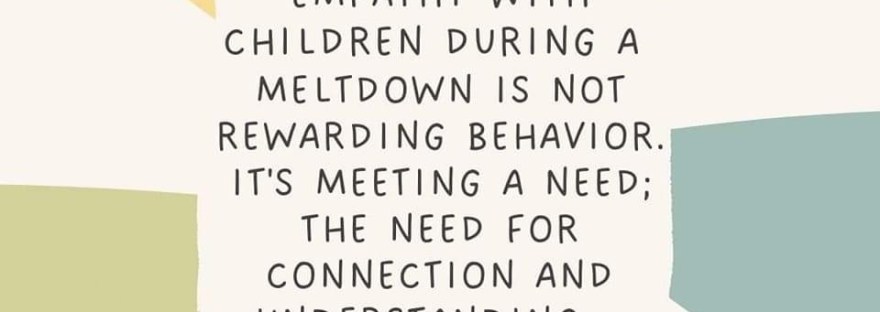
This is an example of restoration. This is a clear example of growth through coregulation over control. This example may be uncomfortable reading as you may have the automatic response or programming to think “no way, electronics are taken away and she should never talk to you like that!” I get it. Unlearning is NOT an easy process- it’s kind of like reprogramming an operating system that’s been functioning for 40 years. It’s not easy and unfortunately, it takes practice and experiences to experience the impact of slowing down to connect and not control, yet each time you try- you’ll feel the value of your efforts.
In conclusion, I know my parents were incredibly impactful in my childhood. They did their best to provide me opportunities to thrive and make a positive impact on the world around me. I don’t have any discipline traumas to speak of because I felt my actions were coupled with appropriate discipline response. Yet now being a parent myself and after powerful conversations and reflections with my parents, it’s been beautiful to discuss how parenting has been so different for me as it was for them. Therefore, I encourage you to reflect on how you’re building resiliency in the youth that you lead. Are you responding or are you reacting? If my reaction was bigger than I/they liked, how can I reconnect for restoration? Am I aware of the nuances of the needs of my child? How am I managing my emotions and how am I modeling emotional response?
To wrap this up, please remember, parenting is a process and the more you can reflect on the progress, you will continue to make great impact. Each child (and human) are designed beautifully different and each generation has varying social and emotional influences, thus we need to continue to commit to being responsive (not reactive), compassionate (not controlling) in order to build resiliency in this new generation.
When a seventh grader randomly told me to ef off and gave me some superlatives, I became curious. My unexpected “Ok. Would you like to go for a walk” response disrupted her “attack.” She was expecting me to give her big feels but I didn’t. Instant confusion followed with a hair flip and a timid “ok.”
After I listened to her vent about the vice principal and how much she hated her and blah blah blah, she welcomed me into her story, the true story. By just listening and calmly redirecting her language use, she mellowed down and somewhat dropped her verbal attack.
She requested to see the counselor after taking a short sensory break. Her kinetic sand manipulation and sassy reflection led her to being ready to share the cause of her anger.
And it wasn’t the vice principal. It wasn’t me. It wasn’t the poor kids receiving her targeted hurtful words. It was what she was carrying into school and had yet to process. She truly has legitimate reason to be angry. Yet she was alone in her anger. Big mad needs to be processed through or it will go somewhere- often misdirected which only creates secondary consequences.
Sharing this experience with this student reminded me once again- no child (or adult really) wants to feel the big mad feels. Therefore it is our responsibility to be curious before furious. It is also our responsibility to create boundaries to guide healing and less intense big mad responses. Not eliminate big mad, but better process big mad. And guess what?!? The starting point is you and I. As adults (25 and up) we have a fully developed prefrontal cortex (the part of our brain that helps us with decision making and self control.) Therefore it is our role to model in our language, tone and body position how to respond to big mad and big feels. As we demonstrate through our response to big mad, big mad can visit with less intensity, frequency and duration.
In conclusion, our students come to us with unsaid challenges, new beginnings and growing brains. It is our gift to meet them where they are and love them through it. Through curiosity, compassion, healthy healing boundaries and restored hope, we will can lessen big mad and come together to support each other through hard things.
“… belonging and being loved are core to the human experience. We are a social species; we are meant to be in community—emotionally, socially, and physically interconnected with others.” – Bruce D. Perry
Part 1: Neurobiological Need for Connection and Relationship
Your brain is constantly seeking felt and physical safety in your environment and experiences. This is called your interoception. Unconsciously our brains are scanning the environment and experience for safety and threat. Our senses provide the brain with the activators of response or rest. What makes this radar system complex is how it determines “safe” or “danger” in the split second it’s scanning the environment. Our previous experiences create highways to response or pathways to safety. Our nonverbal communication (body posture and position, facial expressions and tone of voice) tell our stress response system to chill out or activate. Knowing this, we can be more mindful of what activated our emotional responses and behaviors. Through this reflection and awareness, we naturally begin to coexist more effectively (and pleasantly).
As humans, we are social beings, therefore we also crave consistent, reliable and authentic connections and relationships. When you feel like you are part of a community, you are more willing to do new and/or hard things.
When you invest your time and energy in a relationship/friendship, you create stronger connections (what I will refer to as “relational mylienation”). As you increase frequency, duration and sometimes intensity within these relationships and friendships, that’s where the “mylienation” or the “strong bond” evolves.
From here, a trusting connection is cultivated as you begin to co-process, co-regulate and reflect on life circumstances. You feel more anchored, safe, reflective and connected to yourself and trusted friend. The challenge to this is when the other person may not reach the same stage of safety as quickly or maybe too quick. This makes the relationship complex as you navigate the intensity of the relationship. Oftentimes, in healthy relationships, these are moments to pause, check in, and clearly communicate to discuss the “rate of growth.” This could be awkward at first- yet it will set up a strong foundation for communication and growth.
Yet on the contrary, relational well-being is sometimes challenged by circumstance and control. These seasons, times or moments are hard because of the strong connection built in the relationship or friendship. During these times, you also seek out your trusted community to anchor yourself, restore strength in your perspective and resolve the relationship challenge while keeping your well-being in mind.
If you’ve never faced the waves of well-mylienated relationship challenges, this may sound easy. Though if you’ve endured these “waves” in time, you know they aren’t easy. Either way, we are neurologically wired to seek out others to help us get through tough things.
Considering this, how can you know that you have a secure “safety net” built for life curve balls (and confusing detours)?
First and foremost, get to know yourself. What I mean by this is- seek to understand, develop awareness and explore your mind and body connection. What stirs you up? What settles you down? Next attune to your relational investments. Who makes you feel recharged? Who drains your battery?
These two explorations alone will help you “prune” some of your relational investments and nurture others. You’ll also find yourself more anchored and aware of yourself in social and non social situations as you attune to the energy you give and receive.
From here, you can simply begin “mylienating” these relationships and friendships to cultivate growth, connection and relational wellbeing.
Simply put, through attunement and awareness of the mind and body response to our relational energy investments, we are better able to balance and boost our emotional and relational wellbeing.
Part 2: One-Sided Co-Regulation
As a human, your relational and regulation energy is contagious. This is both a positive thing as well as a challenging thing. Without words, our energy can be transferred simply by being in presence with someone. Considering this, a problem arises. What if the other person, who may be dysregulated or dealing with toxic stress has developed barriers and shields over time? They are doing whatever they can to not absorb your calm contagion. How can you support their well being without it negatively influencing YOUR well being? What can you do to meaningfully support the well-being and relationship without it becoming toxic stress?
With this inquiry, I think of my most challenging students. Oftentimes they are carrying in their big behaviors because they’ve learned them as coping strategies as they deal with the toxic stress in their families and/or homes. They’ve learned how to manifest and create chaos for their comfort. They engage in negative peer interactions and adult defiance and disrespect from learned behaviors. This takes all the heart and patience of the co-regulating adult to persevere, teach and love them through their big feels and big reactions. Yet the secret is- they don’t take these behaviors personally AND they check in with their nervous system during and after these interactions and experiences. These are the two keys to emotional and relational well-being. Now when it comes for adults experiencing these challenging experiences, it leads me to a second reflection for application.
As Maya Angelo reminds us, “When you know better- do better.” Considering this, when adults demonstrate a disconnect of emotional response and circumstance (bigger, louder, intense, unexpected), often times It could be from one of these thing.
They are going through hard times and may not feel seen, heard or valued (relational well-being)
Don’t have healthy of helpful coping strategies (self and co-regulation)
They have yet to befriend and/or understand their Stress Response and Nervous System influence on their reaction and response (neuroanatomy knowledge)
Because we are biologically wired for connection, when another human responds unexpectedly, it puts OUR stress response system on fight, flight or freeze mode which directly impacts the response and in turn the relationship. Things are said that require rupture and repair. Resolution is not quickly established and it all gets far more complicated than first intended. This happens to all of us. We are human. Yet the more we understand our nervous system and behavior response pattern, the better our responses become in stressful situations. Our fight, flight, freeze response becomes better programmed and our relational well being (with ourselves and others) improve. How we repair our relational well-being is how we can heal our nervous systems to be more anchored and meet our biological need for connection and community.
Relationship Mylienation
Therefore, I go back to the beginning point, relationships and friendships take commitment and meaningful reflection to evolve and ‘mylienate’ over time. Developing skills together and being aware of your behavior and response based on neuro- and biological needs, you will continue to be anchored in yourself and your relationships. You can better choose how to invest in your relational well-being.
Also, I encourage to find a community that uplifts you and you can also co-process challenging things with. When you find a ‘tribe’ that can support you though relationship ‘mylienation’, you’re going to have better outcomes as you can authentically reflect, restore and rebuild your relational wellbeing.
As we are here together and you are actively listening to what I am sharing, I want you to settle in where you are. Try to find your body’s rest point and fall into that space. Once you’ve found your comfortable position, take a slow breath in through your nose, feeling your body melt into the position you are anchored at, and release a slow, steady exhale out.
Today we are going to explore our internal engine. We are going to check it’s rpm’s and how our engine is running. As you are listening, put your right hand onto your chest. Take a moment to connect to your “engine” that’s running. Is the motor “purring” or in idle? Is it revving it’s engine, ready to move forward to the next thing? Or is it steady on a cruise? You can check it’s status by the rate of your heart (beating fast, slow, steady) and the depth of your breath (shallow, deeper).
As you connect with your engine, let’s also attune to the other parts of our vehicle. Let’s bring our attention to our feet. Do you sense tension or grounding in your toes? Do you feel like you have good “traction?” If not, give your toes a squeeze and release or rotate your ankle to check in with the “pressure” within your foot to empower your toes.
Next let’s go upward to your navigation station (your head). At this moment, let’s place your hand back into a comfortable position. Let’s then close our eyes (if you’re comfortable) and do a small head rotation in whichever direction your body leads you. Let’s do two rotations, slow and steady. As you do so, pay attention to your breath. Are you holding your breath or are you still able to control your breathing pace? If you need to take a cleansing breath, please do so now.
As you continue to listen, let’s discuss how your navigation station is impacting your engines pace and readiness. First, your breathing is the key power to the capacity of your vehicle. You breathe in the air to empower and release the toxins when nutrients are absorbed as needed to safely pace the engine. If you breathe in too hard, too fast, sometimes the engines stalls. If you don’t breathe in and out deep enough, the engine will need to be serviced sooner than if you focused on taking in deep breaths as the engine is always going.
As we wrap this up, I invite you to take a steady breath in, feeling your engine with your hand on your chest, and as you slowly exhale, wiggle your toes and rotate your head slowly so you navigation station and traction is set for a safe pace to your day. Thank you for checking your engine and getting ready for a great opportunity for smooth cruising.
By taking the time to better understand yourself, you unleash an inner capacity that courageously propels you forward. In due time you realize what had you tethered which creates a compelling release when you become untethered. In other words- when you understand what serves you best and what you value most of all- it’s anchoring to stand up for what you believe is best for yourself and others.
Now for some context- I’ve spent more time with my mind than I have ever done before. With the Covid craze, the continuous shifting and risk evaluation, I have developed a stronger sense of self. Fortunately and unfortunately, I have clearer boundaries. Because of this evolution, it’s created some ripple effects. I have lived my life to be a chronic people pleaser and so much so that it’s become an expectation when responding to requests and interactions. To say the least- it’s been somewhat surprising when I say, “no thank you” to some of the things I’ve typically said “sure” to.
Now for clarification- I’m extremely positive with my mindset and approachable in problem solving. What has evolved for me is HOW I respond to life’s decisions. I’m less emotional in quick response and anchored in my willingness to contribute to conflict resolution. In the past, oftentimes I became uncomfortable with conflict and either shut down or cried because there was conflict in itself. Now, with vulnerability and courage, I can comfortably contribute to conflict resolution with clarity and composure. Essentially, I am more comfortable with being unapologetically authentic.
How did I get there? You ask. Oh I’m not there yet. It’s an everyday, every situation, every interaction evolution. Through reflection, genuine connection and conversation, I’m able to improve and become better as I grow into my being. Heck- I’ve been here for 40 years, it’s about time.
Let me stop here for a second. I’m not becoming a new person. I’m not being radical. I’m still me. I’m still a positive presence. I seek to uplift, encourage and empower those around me. I provide positive energy to the communities I contribute to and an active problem solver while I provide positive and impactful feedback to others. The greatest evolution for me is- I’m not afraid to be honest, I’m not afraid to speak up, or admit that I made a mistake. I am invested and it’s critical for me to be genuine in my responses and speak up with what matters most to me, my team and my family.
What piece of advice do I have for YOU as your pursue your best self? First- I validate the courage and vulnerability it takes to be REAL most of the time. Second, sit back for a little bit and “read the room.” Just watch. What stands out to you? What triggers you? What excites you? Listen to the energy in your body. Watch your heart rate on your watch. Your body responds to you more than you may realize. Attuning to the sensations in your body and the thoughts in your mind is the greatest feedback you can receive. Just listen. Lastly, say yes to something for yourself. You may often say yes to someone else a lot faster than you do for yourself. Go get that latte, buy yourself a new color nail polish, take a bath instead of dishes, go stand outside barefoot and feel the rain or breeze. Do you something that empowers you to get to know yourself better. As you continue to attune, your heart and mind will lead you forward.
If you’d like more tips to attune to your mind and body, please reach out to me. I’m passionate about being true to yourself and embracing the gift of being unapologetically authentic.
As we take off on our journey to seeking to understand the value in providing appropriate accommodation for our diverse learners, it’s important to recognize a few things.
First, if you are a teacher, educational leader, parent of a neurotypical or neurodiverse child, this experience is for you. You want to best understand how to support the youth that you lead.
Secondly, supporting the neurodiversity in the nervous system needs of the little humans that you lead is not as complex as it sounds. It’s valuable, especially when done right. (And you CAN do it right).
Lastly, mental health is at the center of so many more conversations than the past. Let’s celebrate this. Yet, let’s not ‘fluff’ or ‘bandaid’ mental health challenges. Let’s get to the roots. Starting here. By understanding our sensory and nervous systems so we can understand, unfold, and undo the impact it has on our behavior, decisions, and relationships.
Yet, before we go into the conversation about the tools used for regulation, lets start with a foundational understanding- We all have a nervous system- therefore we all have nervous system needs. These needs vary due to prior experience, daily circumstances, trusting relationships, and basic needs being met. Because of this, its crucial to develop awareness, language and supports based on our sensory and nervous system needs.
Therefore, starting today, I take you on a journey of exploration to consider effective accommodations for nervous system needs. You will understand how to support self regulation, behavior response and mental health of not only the youth you lead, but yourself as well. You will have less conflict and effectively respond to challenging behavior
After spending a couple days with my sensory lens on- I realized how much I navigate my life using my senses as a radar in creating safety and support for my family. By understanding how my senses program my nervous system response (aka behavior), I’m able to identify the cause and effect relationship. In doing so, I recognize the source of regulation is through my nervous system and my nervous system is getting information through my sensory organs.
Which leads us to the purpose of this series: Get to know our sensory systems’ function and how it effects our behavior response so we support nervous system needs with effective accommodations.
Nervous System and Sensory System Relationship
Again, getting to know how our sensory system communicates with our nervous system is vital to creating behavior change.
Definition:
Let’s define the relationship between our nervous system and sensory system. In this, we will discover
The sensory nervous system carries signals from various receptors (sense organs and simple sensory nerve endings) to the central nervous system (CNS). This pathway informs the central nervous system (the brain and the spinal cord) of stimuli within and around the body.
Considering this, your sensory system composed of your sensory organs (ears, nose, mouth, eyes, skin) are the inputs to the central nervous system. Our central nervous system is then sending messages of action for our body and brain to release certain chemicals to create action and reaction.
In this basic definition, it creates the clarity of the value of getting to know what we are processing though sensory input and if the message is creating a stress response in our central nervous system, how important it is to utilize our senses for reset and regulation. Therefore, we will be using your senses to explore interventions and accommodations through this series because truly- it is the starting point to the cause and effect of behavior.
Some Basic Management Tips
With the title “It’s not entitlement, its effective accommodation,” I want to ensure that we have a shared understanding. A sensory tool is only effective if it’s managed and utilized intentionally. Therefore, I hold these parameters when introducing them to my students, self and child.
It’s a tool, not a toy. The moment you recognize that you feel regulated and ready to return, listen to your nervous system, and return.
If your nervous system is not returning to regulation with that tool, utilize another sensory system tool for support.For example, if your using an auditory tool (noise cancelling headphones) and you still feel your heart rate and breathing as high, try a tactile tool (a squishy ball).
Sensory Tools are not meant to distract you from your learning or doing. It’s to support you become regulated and ready to ‘get to your cortex.’ Becoming self-aware of time needed for regulation is important. It’s important to remember the purpose behind the practice. I teach self awareness through this, yet I am also aware of the behavior when engaging in using sensory tools. I provide feedback and support in efforts to develop self-management and self-regulation.
Auditory Sensory System
Starting now, let’s explore our essential question around the Auditory Sensory System: How does audio processing impact your behavior response?
Definition:
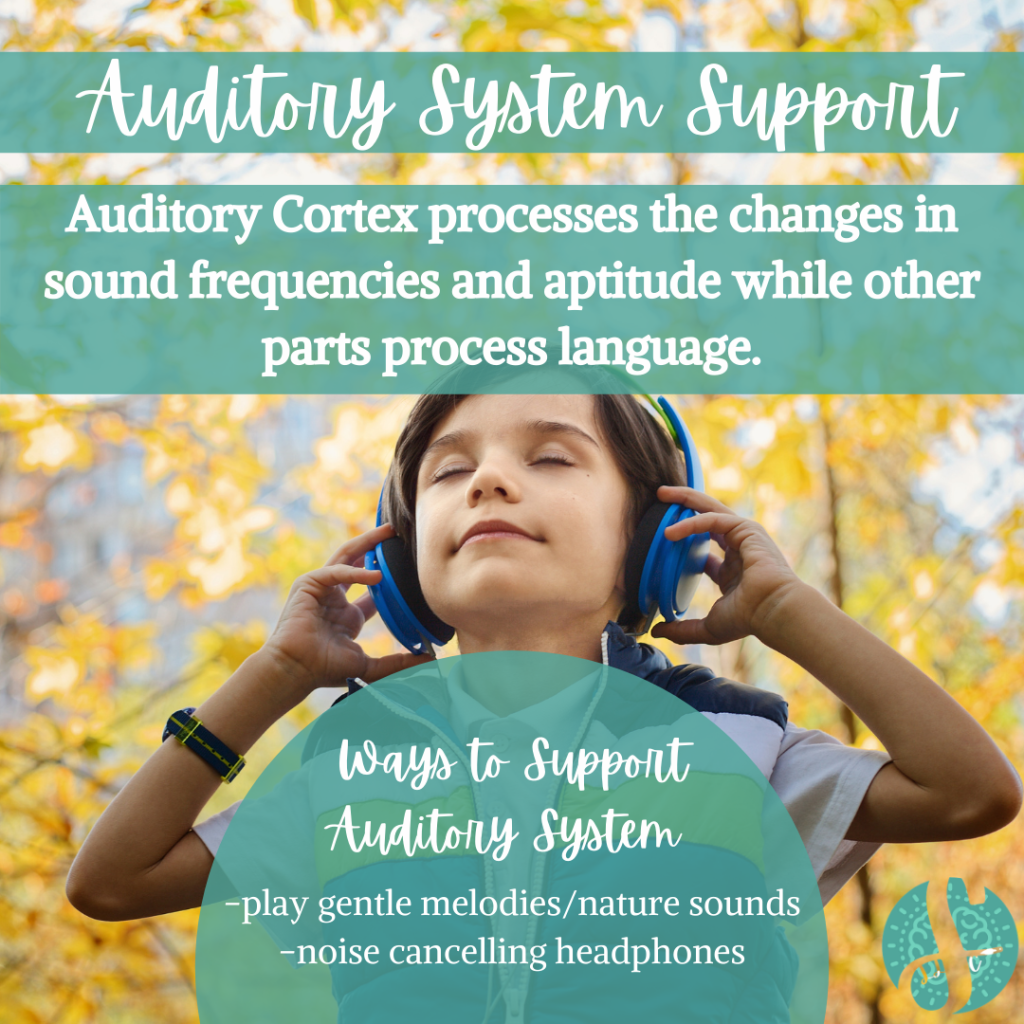
Auditory Cortex processes the changes in sound frequencies and aptitude while other parts process language. Therefore, our auditory system is focused more on the speed, tone, voice level BEFORE processing language.
As a teacher and as a parent and partner, it’s important to recognize that our brain is interpreting these things before anything I say. Again, a necessary understanding in supporting our students get to their cortex (and our teaching to ACTUALLY be listened to and process as learning).
Facts:
Ninety percent of a growing child’s knowledge is attributable to listening to background conversation. Therefore there is value in being aware of what you are saying AROUND them, not just TO them
What we hear, what we see and what we smell is absorbed the same way- through energy. Being aware of the energy absorbed can help us understand effective support to regulation.
Anecdotal:
My beautiful daughter has sensory processing dysfunction. When it comes to sensory input, she is either overstimulated or understimulated and her behavior demonstrates the over or underwhelm that she is experiencing. By understanding that her behavior is communicating a sensory over or underwhelm, it helps me better respond and be proactive in communication and support. Through this, our relationship and communication has been strengthened through sensory awareness and understanding.
As this series started with taking note of observations with my sensory lens on, let me share with you some noticings. This will further us into sharing what ‘effective accommodation’ looks like versus entitlement.
First, I had a dear friend remind me a very important thing when it comes to communication and it connects to our auditory system: Don’t let the mess, mess with the message. In other words, amplifying your voice (yelling, ect) actually interferes with the communication of WHAT you are saying because your nervous system received the voice LEVEL and is actively determining if the message will be safe or friendly and in processing, misses the message itself! So, low voice and slower speed actually helps our brains receive the message (not the mess).
Next, through awareness, we can process less than expected sounds. For example, when my daughter is activated by an unexpected, loud or unfamiliar sound, she gets overwhelmed and shuts down. I’ll never forget the first time she heard a hand dryer. She demonstrated a sensory meltdown and covered her ears and screamed (to have control over sound input) and essentially had a nervous system response.
With this, we have to be more aware of our environment and be prepared for unexpected sounds and behavior response. We have also taught our daughter to have self-awareness as well and communicate when she can. If the TV is too loud or if the environment she’s in is creating overwhelm, she can ask for a sensory or sound break (leave the room, put on headphones, etc.). Because of the support from her OT, research on sensory processing and loving support, she has grown in communication, adaptation and resiliency.
As a teacher, these tokens of practice have been monumental in supporting children in the classroom environment. When a child is challenged with the announcements on the speaker, I no longer corrected them for ‘not listening’ when putting their head down and covering their ears. I now ask them targeted questions: Are the announcements too loud for you? Is the sounds of the learning challenging for you? Which lead me to appropriate accommodation and support.
Application:
When a student or child is experiencing either a sense of overwhelm or underwhelm when it comes to auditory processing, the accommodation is appropriate based on if they need more or less auditory input.
Auditory Underwhelm (need more input for regulation)
Auditory Overwhelm (need less input for regulation)
Calm and Nature Music (either in headphones or whole class environment) Create sound in a non-distracting space (be able to sing / talk loudly in a non-distracting space)
Noise cancelling headphones Quiet/silent workspace (this accommodation is most for those with auditory overwhelm)
Keeping the above in mind, it is CRITICAL to remember that the tool for accommodation must align with the sensory need. If a student is seeking auditory input (because their not getting enough) and demonstrating the need through yelling, tapping and humming, providing noise cancelling headphones would amplify the need, not support it. Therefore its equally important to understand what behavior is communicating: need for more input or less input. On this journey, you will begin to understand the difference between the two.
Wrap-Up
If you are an educator and would like to apply your understanding of sensory processing in your classroom environment and experience, subscribe below for impactful resources.
Your students and self will be more reflective, regulated and connected. You will develop authentic community and communication and experience sensational synergy in your classroom and school community.
My dearly loved boyfriend at the time was flying off to Japan for the year. He was serving as a Marine at the Okinawa Marine Corps Base.
Yet after saying ‘see you later’ at the airport, I received a call that he was returning to SeaTac. I was going to be there. No matter what. Yet, truth be told, I had not slept the night before and it was currently 9 pm. His flight did not come in until 11ish. And did not take off for Japan until about 3am-ish.
My parents adamantly told me that I could not go because I was ‘too tired’ and to be ok with the ‘goodbye already given.’ I distinctly remember the intense conversation that I straight up said, “Too bad, I’m going anyway. You cannot tell me what to do. I’m an adult.” Words that still sting today as I type it.
And so, I did. I went. Mind you- the airport is about an hour and a half away. Quite a drive for a 19-year-old (or anyone really).
Arriving at the airport and enjoying the gifted time in between, I was adrenaline-ized, focused on soaking up the moments and not feeling the slightest ounce of tiredness. My brain and body were NOT connected in recognizing the level of fatigue I was experiencing.
Therefore, as I left the airport, after the second emotional ‘see you later,’ I drove home about 3 am (again an hour and a half drive). As my body and mind became more connected, and fatigue set in, my body hijacked my mind. I fell asleep at the wheel and got in an almost life ending car accident approximately 9 minutes from my house. I almost made it home.
To this day, I don’t remember ever ‘dozing off’ or ‘feeling tired.’ I also do not remember anything that happened. The last memory of recall was the tree line shortly before my accident (it is clear as day in my mind). I cannot tell you how grateful I am that I do not recall the pain and trauma of that accident as I know I would have much deeper pain to recover from. Yet, I also acknowledge those that viewed the level of trauma that I experienced.
From this moment, I was airlifted to Harborview Hospital in Seattle due to the level of injuries from the accident. At the early hour, I was grateful that there was another driver on the road who witnessed the collision and was able to call for help. I am also grateful that a dear friend of mine was a paramedic who was at the scene.
Yet, I cannot imagine the response my parents had when they found out what had happened. My dad was on his way to work when he drove past my car accident scene. I cannot imagine that feeling. Typing this is creating emotion, thus reading may be creating it as well. It is unimaginable.
By the time he flipped around, they informed him that I was in transport to Harborview. My mom and sister were quickly notified, and they were on their way to me. With police escort, they got on the ferry and got there as fast as possible. Sitting on that ferry must have been incredibly hard. I think of it each time I get on the ferry.
Again, I do not remember anything after my accident, so this space is a space in between. I feel like I need to allow for my parents, family members and friends to fill in this space. And this is the space of gratitude that runs deep in my soul. I welcome you to share what you remember and share with me your story. I receive your experience with compassion and care. Thank you will never be enough.
Though the moment of ‘awakeness’ is clear to me. It was NOT in the hospital- I ‘woke up’ when I was at home. They sent me home (yet I have no recollection of the send-home). Yet, it was too soon. My electrolyte level was too low and I passed out in the shower. Therefore, I was sitting in the downstairs living room in a towel surrounded by paramedics and my parents sitting next to me. I joke today of this memory as my confusion created embarrassment. I was naked around these paramedics and firefighters in my home. Getting clothes on me was my tall order (at least that is what I remember in my mind).
From there, I was escorted by ambulance to Harrison Hospital. I remember riding in the ambulance and seeing the newly built McDonalds (and asking for a burger.) Again- these are recollections in my current mind. These moments were very spotty in memory, much like multiple little dreams you experience in your sleep.
Thereafter, I remember sitting in a Harrison Hospital room upon which I was eating a popsicle (I think) and was told that I was going to Seattle back to Harborview. I feel like I ‘blacked out’ from there as I do not remember being transported (by airlift) or experiencing any pain, so I was confused and complacent.
As I spent most of my treatment at Harborview, I have been told multiple stories of my behavior- some funny, some embarrassing. Again, this is a time in between that I think my family and friends could fill in. (Yes, I welcome you to share 😊)
Furthermore, I remember my first “wake up” in my hospital bed (please forgive me if this sequence is off). I woke up when I was getting my catheter taken out and remember yelling about it. I also remember being fed by the nurse. I also remember the celebration of my family when they saw me. I also remember the room and the view to my left (small unimportant details.)
When I left the hospital, I remember walking with my friend Emily and our Malibu Work Crew Leader Ti-Ying. She flew out from New York. To this day, this moment humbles me. True friends taking care of me. Again, forever grateful.
Coming home, I remember needing to consume lots of Otter Pops and lots of Gatorade. Something unknown till experienced, but these two food items help your electrolyte levels! I was totally okay with this ‘prescription.’ Yet its funny because neither of these food items are regularly stocked in my home. Maybe I should change that….
I also remember feeling like nothing was wrong with me. I felt my mind was fine. I remembered who people were and everything felt familiar, as if nothing really changed. Yes, I spent time in the hospital (in my conceptualization was only a couple days) but I was home safe. I did not have any scars (for real) and felt no pain (seriously), so it was a very confusing time.
Though, the moment I went to my speech therapist, I better understood the challenge. When asked to share words that started with “a”, and I could not, I broke down. Something WAS wrong with me. I am not exactly sure what created the pivot of perseverance, but I can conclude that it came from the combination of hope from my family and the compassion from my speech therapist. I have a deep gratitude for Dr. Michael (I want to remember his last name as thank you is due).
Conclusively, I am a testament to Neuroplasticity. If you do not know the term, read the story above. I recovered from an almost life ending brain injury. I have dedicated my life to sharing the hope in healing and the possibility of positive perseverance. We can do hard things.
I have supported my students in challenging academic tasks because I understand there is more than one way to learn. Having to relearn how to learn was life changing.
I have also been able to understand the behaviors behind brain-based challenges. This has helped me better respond and support challenging behaviors for myself, my students, and my family. Because of this, I can genuinely grow through adversity and support others authentically as they go through hard things.
Something that still warms my heart to this day, is the amount of abundant support my family received. I will never forget my bed full of stuffed animals and my room filled with balloons. I still have the poster sized card that everyone signed, and the cards given during my time at the hospital. I know that I recovered due to the loving support of the community that surrounded me and my family.
Altogether, my story radiates strength, resiliency, possibility, and promise. I am honored to be a messenger, mentor, and motivator of all of these things. It is a gift and an honor and I am forever grateful for those that have supported me throughout the years. Thank you will never be enough.
I recently did a podcast on masking but I can’t get it out of my head! Now that the concept is so fresh and real to me- I feel like I’m seeing it everywhere!
Why do we need to feel like we need to hide from our true selves? What makes it challenging for us to be vulnerable and real? Unleashing your real-ness takes vulnerability and courage, yet why? Peeling the layers away from what you’ve hidden from is freeing, yet it’s also incredibly difficult in a society shaped by “norms.”
I understand the law and order idea to this too. Yes, having expectations is valuable most of the time, yet WHAT expectations and how they are enforced is what should be explored.
Now, let me revisit the term “masking.” The Neurodiversity Association defines “Masking” as concealing neurodiverse traits in order to fit in. (What is neurodiversity? – Neurodiversity Association) With this definition alone, it demonstrates the ‘conformity’ behind the idea.
I validate the real-ness behind ‘masking’ for our neurodiverse children and adults, yet are the neurotypical humans creating this need to mask? Exploring this potential is powerful. How can our neurotypicals (who may not empathetically understand the neurological challenges of others) be more comfortable with differences? We need to build experience and understanding to be more inclusive in conversations and experiences. Honest and true- we have more in common than you may think!
So let’s go there. We all hide from something. We all try to make others comfortable and hide our struggles. I mean- think of a world where we could embrace our honest nervous system navigation. We’d support each other and be more comfortable with what we’d be going through and recognize that though we may be different- we’d still be valued as an INDIVIDUAL.
Let’s think about the different ways human beings “mask.” Then we will explore how neurodiverse minds are challenged by masking.
First, I think of our Black Lives Matter movement right now. They’ve been challenged with the social masking due to systemic inequities throughout our history. This impacts their behavior (heightened stress response), trust (in leadership and systems) and everyday interactions. I strongly believe that putting the intergenerational trauma of racism on the table is important for UNIFICATION. Let’s be real. Systemic change is needed. Equity should begin to be the norm. Taking this mask off takes vulnerability for ALL races. Yet- it’s possible. Let’s have a conversation to lead to correction and direction.
Next- I think of our soldiers who return from war. We do not have a well-designed system or reintegration into society. They have gone through radical nervous system training for survival and then to come back to the ‘free society’ and have to rewire their nervous system without support creates masking behaviors. By not recognizing the impact that soldiers experience when they return from combat is encouraging unhealthy masking behavior. Let’s effectively (and quickly) create systems of support for our honorable Veterans. PTSD is more prevalent than identified. Let’s support their nervous system healing.
Lastly, lets explore how neurodiverse minds have ‘masked’ their neurodiverse traits around neurotypically designed systems and expectations. Essentially, we all have a nervous system activated looking for cues of safety and danger. We are unconsciously scanning our environment seeking predictability and comfort. When our nervous system sends signals to our brain to react and respond to what our senses are processing, it creates our behavior and engages our level of response. Do we flock, freeze, fight or flee when we signal a behavior that’s uncomfortable or unfamiliar? Truth be told- your physiological response (body reaction) oftentimes creates the discomfort that creates masking behavior in neurodiverse individuals. That, and… potentially your language, tone and interaction as well. Oftentimes, unintentionally.
Therefore, I give you a small challenge that’ll reap widespread reward. Be aware and attune to your nervous system response (body and mind connection) when experiencing an uncomfortable behavior in yourself and others. When doing this, you may realize that you may be demonstrating ‘masking’ behavior and/or encouraging others to ‘mask’ theirs.
Again, it all comes down to creating unification amongst our differences. By no means should we be divided because of our discomfort. Let’s seek to understand. Let’s accept one another when going through something not-so-easy. Let’s build inclusive systems and expectations. Let’s empower Sensational Synergy by seeking to understand ourselves and each other better.























 Sensational Synergy