
person holding babys hand
Parenting

Parenting with Emotional Synergy

Synergythe bonus that is achieved when things work together harmoniously.” – Mark Twain

As a parent, I always want the best for my child. She’s my one and only. In her first decade of life, I have learned more about myself through her. She’s opened my eyes to many things I never saw in myself.

She’s shown me that I can be courageous while also being cautious. I can be strong, while also being sensitive. She has empowered me to embrace my true self and in this authenticity, I believe in our capacity to do great things, even when they aren’t easy.

Now, for a little bit of “Title” tossing-out. My daughter and I have both been officially diagnosed with Generalized Anxiety Disorder. With this, we are able to support each other’s challenges with compassion and connection. Yet, that doesn’t mean it’s easier because of empathy. Our emotions and stress can still get in the way of our daily functioning, but we can support each other without judgement.

Secondarily, through my own personal journey, I have discovered that I am an Enneagram 9 and most definitely considered a “Highly Sensitive Person.” Yes, that means that I have a big heart and care about others, yet it’s also a genuine physical and emotional experience for me. I feel more deeply and experience life more richly.

Lastly, my sweet daughter has challenges with Sensory Processing Integration. What this means is that her brain has a difficult time processing the sensory information it receives which can create heightened physical and emotional responses. In other words, her brain in uniquely designed to deeply experience her daily life.

Generalized Anxiety (GAD). Highly Sensitive (HSP). Sensory Processing Integration( SPiD). These terms or labels are not deficits, they are strengths and will continue to build resiliency through connection and reflection.

With this, I had an experience that helped me realize that not everyone has this ‘feel deeply’ experience.

I’d like to provide this scenario to help generate some truths behind navigating parental challenges. Again, my daughter has a beautifully designed nervous system that leads her to embracing life deeply. She is courageous and brave while also timid and tense. Therefore, when conflict arises, she can sometimes react bigger than expected.

For example, when she felt her friends weren’t listening, she told them that she “hated them.” Which then led to responses like “you’re overreacting” and “you’re mean.” Developmentally, this is a ‘sometimes expected’ response. Pre-teens are navigating how to best express themselves emotionally and most often its more intense than they even expect it to be.

This is where the unique awareness for myself as a parent came in. When I read about this interaction (virtual exchange between school friends), I recognized the somatic experience it gave me. I felt those tingles and numbness that you’d feel when someone said or did something hurtful. It was interestingly an empathetic physical response. I felt as if the words were spoken to me. And this is where I am grateful for my awareness that can lead me to a rational response.

My nervous system response led me to an emotional response of sadness and a physical reaction of numbness and wide-awake-ness. Oh did I mention it’s 1:30 am as I write this? Probably not because I know I should be sleeping yet my emotional processing has me physically wide awake.

Going back to the scenario, I ask myself, How can I support my child through validation (of her big feels), reflection and restoration?

I have learned what I shouldn’t and won’t do- have an immediate response of anger, punishment and shaming behaviors. Unfortunately this is the typical-ish response in parenting- respond with intensity to eliminate behavior. By doing this, it simply invalidates emotional and social development and shuts down the ability to grow through the hardship.

Do I believe in accountability- you betcha. Yet how the accountability is communicated is the key element in this scenario, I mindfully choose my language and best frame my reflection questions with curiosity not shame. The “tell me more” request remains the most powerful statement. When I am able to validate the feelings she’s sharing with me, it also creates a safety that builds her resiliency as well as self-compassion.

By investing my energy into seeking to understand, it encourages my daughter (and others) to re-evaluate the situation and be able to become more collaborative in problem solving. Now because of this, I am hopeful that when scenarios arise such as the one shared above, I will be able to remain compassionately curious, not concerned about the outcome of the hardship.

I genuinely want the best for my daughter and will remain intentional about my self-awareness of my response and do my best to empower resilience through authentic emotional processing. I will need practices like these (written reflection and communication) in order to remain calm and curious when supporting the social and emotional challenges that may arise.

For encouragement, when you are invest in your self-reflection and awareness of your reaction and response to the events and experiences of parenting, you are a great parent. There is power in restoration because you’re not always going to get it right. You’re human. By getting to know yourself and your child, you’ll experience the synergy to be able to work together and do hard things.

black and white laptop
Photo by Prateek Katyal on Pexels.com
sad woman standing on coast of sea at sunset
Sensory Processing

“It’s Not Entitlement- It’s Effective Accommodation”

As we take off on our journey to seeking to understand the value in providing appropriate accommodation for our diverse learners, it’s important to recognize a few things.

First, if you are a teacher, educational leader, parent of a neurotypical or neurodiverse child, this experience is for you. You want to best understand how to support the youth that you lead.

Secondly, supporting the neurodiversity in the nervous system needs of the little humans that you lead is not as complex as it sounds. It’s valuable, especially when done right. (And you CAN do it right).

Lastly, mental health is at the center of so many more conversations than the past. Let’s celebrate this. Yet, let’s not ‘fluff’ or ‘bandaid’ mental health challenges. Let’s get to the roots. Starting here. By understanding our sensory and nervous systems so we can understand, unfold, and undo the impact it has on our behavior, decisions, and relationships.

Yet, before we go into the conversation about the tools used for regulation, lets start with a foundational understanding- We all have a nervous system- therefore we all have nervous system needs. These needs vary due to prior experience, daily circumstances, trusting relationships, and basic needs being met. Because of this, its crucial to develop awareness, language and supports based on our sensory and nervous system needs.

Therefore, starting today, I take you on a journey of exploration to consider effective accommodations for nervous system needs. You will understand how to support self regulation, behavior response and mental health of not only the youth you lead, but yourself as well. You will have less conflict and effectively respond to challenging behavior

sad woman standing on coast of sea at sunset
Photo by Julia Volk on Pexels.com

Putting on “Sensory Lens”

After spending a couple days with my sensory lens on- I realized how much I navigate my life using my senses as a radar in creating safety and support for my family. By understanding how my senses program my nervous system response (aka behavior), I’m able to identify the cause and effect relationship. In doing so, I recognize the source of regulation is through my nervous system and my nervous system is getting information through my sensory organs.

Which leads us to the purpose of this series: Get to know our sensory systems’ function and how it effects our behavior response so we support nervous system needs with effective accommodations.

Nervous System and Sensory System Relationship

Again, getting to know how our sensory system communicates with our nervous system is vital to creating behavior change.

Definition:

Let’s define the relationship between our nervous system and sensory system. In this, we will discover

  • The sensory nervous system carries signals from various receptors (sense organs and simple sensory nerve endings) to the central nervous system (CNS). This pathway informs the central nervous system (the brain and the spinal cord) of stimuli within and around the body.

Considering this, your sensory system composed of your sensory organs (ears, nose, mouth, eyes, skin) are the inputs to the central nervous system. Our central nervous system is then sending messages of action for our body and brain to release certain chemicals to create action and reaction.

In this basic definition, it creates the clarity of the value of getting to know what we are processing though sensory input and if the message is creating a stress response in our central nervous system, how important it is to utilize our senses for reset and regulation. Therefore, we will be using your senses to explore interventions and accommodations through this series because truly- it is the starting point to the cause and effect of behavior.

Some Basic Management Tips

With the title “It’s not entitlement, its effective accommodation,” I want to ensure that we have a shared understanding. A sensory tool is only effective if it’s managed and utilized intentionally. Therefore, I hold these parameters when introducing them to my students, self and child.

  • It’s a tool, not a toy. The moment you recognize that you feel regulated and ready to return, listen to your nervous system, and return.
  • If your nervous system is not returning to regulation with that tool, utilize another sensory system tool for support. For example, if your using an auditory tool (noise cancelling headphones) and you still feel your heart rate and breathing as high, try a tactile tool (a squishy ball).
  • Sensory Tools are not meant to distract you from your learning or doing. It’s to support you become regulated and ready to ‘get to your cortex.’ Becoming self-aware of time needed for regulation is important. It’s important to remember the purpose behind the practice. I teach self awareness through this, yet I am also aware of the behavior when engaging in using sensory tools. I provide feedback and support in efforts to develop self-management and self-regulation.

Auditory Sensory System

Starting now, let’s explore our essential question around the Auditory Sensory System: How does audio processing impact your behavior response?

Definition:

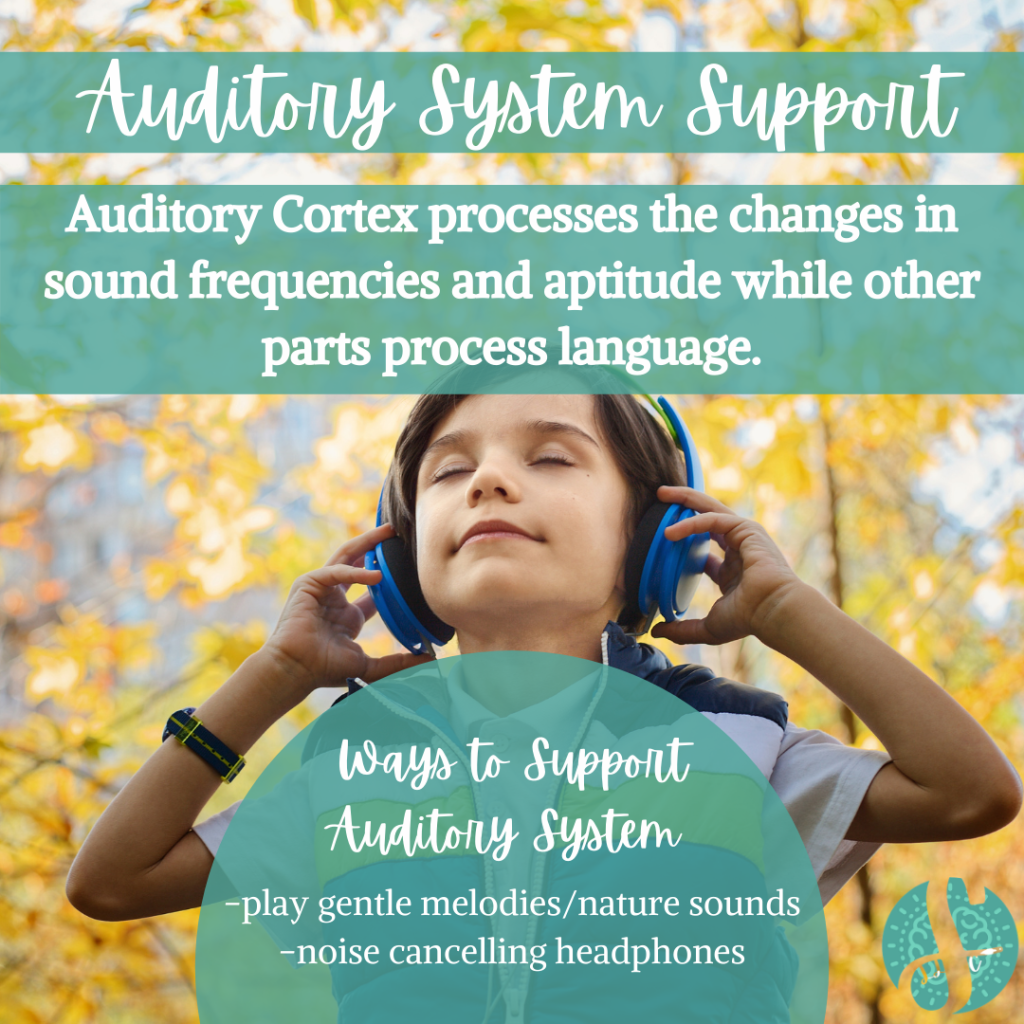
Auditory Cortex processes the changes in sound frequencies and aptitude while other parts process language. Therefore, our auditory system is focused more on the speed, tone, voice level BEFORE processing language.

As a teacher and as a parent and partner, it’s important to recognize that our brain is interpreting these things before anything I say. Again, a necessary understanding in supporting our students get to their cortex (and our teaching to ACTUALLY be listened to and process as learning).

Facts:

  • Ninety percent of a growing child’s knowledge is attributable to listening to background conversation. Therefore there is value in being aware of what you are saying AROUND them, not just TO them
  • What we hear, what we see and what we smell is absorbed the same way- through energy. Being aware of the energy absorbed can help us understand effective support to regulation.

Anecdotal:

My beautiful daughter has sensory processing dysfunction. When it comes to sensory input, she is either overstimulated or understimulated and her behavior demonstrates the over or underwhelm that she is experiencing. By understanding that her behavior is communicating a sensory over or underwhelm, it helps me better respond and be proactive in communication and support. Through this, our relationship and communication has been strengthened through sensory awareness and understanding.

As this series started with taking note of observations with my sensory lens on, let me share with you some noticings. This will further us into sharing what ‘effective accommodation’ looks like versus entitlement.

First, I had a dear friend remind me a very important thing when it comes to communication and it connects to our auditory system: Don’t let the mess, mess with the message. In other words, amplifying your voice (yelling, ect) actually interferes with the communication of WHAT you are saying because your nervous system received the voice LEVEL and is actively determining if the message will be safe or friendly and in processing, misses the message itself! So, low voice and slower speed actually helps our brains receive the message (not the mess).

Next, through awareness, we can process less than expected sounds. For example, when my daughter is activated by an unexpected, loud or unfamiliar sound, she gets overwhelmed and shuts down. I’ll never forget the first time she heard a hand dryer. She demonstrated a sensory meltdown and covered her ears and screamed (to have control over sound input) and essentially had a nervous system response.

With this, we have to be more aware of our environment and be prepared for unexpected sounds and behavior response. We have also taught our daughter to have self-awareness as well and communicate when she can. If the TV is too loud or if the environment she’s in is creating overwhelm, she can ask for a sensory or sound break (leave the room, put on headphones, etc.). Because of the support from her OT, research on sensory processing and loving support, she has grown in communication, adaptation and resiliency.

As a teacher, these tokens of practice have been monumental in supporting children in the classroom environment. When a child is challenged with the announcements on the speaker, I no longer corrected them for ‘not listening’ when putting their head down and covering their ears. I now ask them targeted questions: Are the announcements too loud for you? Is the sounds of the learning challenging for you? Which lead me to appropriate accommodation and support.

Application:

When a student or child is experiencing either a sense of overwhelm or underwhelm when it comes to auditory processing, the accommodation is appropriate based on if they need more or less auditory input.

Auditory Underwhelm (need more input for regulation)Auditory Overwhelm (need less input for regulation)
Calm and Nature Music (either in headphones or whole class environment)
Create sound in a non-distracting space (be able to
sing / talk loudly in a non-distracting space
)
Noise cancelling headphones
Quiet/silent workspace (this accommodation is most for those with auditory
overwhelm
)

Keeping the above in mind, it is CRITICAL to remember that the tool for accommodation must align with the sensory need. If a student is seeking auditory input (because their not getting enough) and demonstrating the need through yelling, tapping and humming, providing noise cancelling headphones would amplify the need, not support it. Therefore its equally important to understand what behavior is communicating: need for more input or less input. On this journey, you will begin to understand the difference between the two.

Wrap-Up

If you are an educator and would like to apply your understanding of sensory processing in your classroom environment and experience, subscribe below for impactful resources.

Your students and self will be more reflective, regulated and connected. You will develop authentic community and communication and experience sensational synergy in your classroom and school community.

References and Resources:

Sensory Processing

What is “masking?”

I recently did a podcast on masking but I can’t get it out of my head! Now that the concept is so fresh and real to me- I feel like I’m seeing it everywhere!

Listen to my podcast episode here:

Why do we need to feel like we need to hide from our true selves? What makes it challenging for us to be vulnerable and real? Unleashing your real-ness takes vulnerability and courage, yet why? Peeling the layers away from what you’ve hidden from is freeing, yet it’s also incredibly difficult in a society shaped by “norms.”

I understand the law and order idea to this too. Yes, having expectations is valuable most of the time, yet WHAT expectations and how they are enforced is what should be explored.

Now, let me revisit the term “masking.” The Neurodiversity Association defines “Masking” as concealing neurodiverse traits in order to fit in. (What is neurodiversity? – Neurodiversity Association) With this definition alone, it demonstrates the ‘conformity’ behind the idea.

I validate the real-ness behind ‘masking’ for our neurodiverse children and adults, yet are the neurotypical humans creating this need to mask? Exploring this potential is powerful. How can our neurotypicals (who may not empathetically understand the neurological challenges of others) be more comfortable with differences? We need to build experience and understanding to be more inclusive in conversations and experiences. Honest and true- we have more in common than you may think!

So let’s go there. We all hide from something. We all try to make others comfortable and hide our struggles. I mean- think of a world where we could embrace our honest nervous system navigation. We’d support each other and be more comfortable with what we’d be going through and recognize that though we may be different- we’d still be valued as an INDIVIDUAL.

Let’s think about the different ways human beings “mask.” Then we will explore how neurodiverse minds are challenged by masking.

First, I think of our Black Lives Matter movement right now. They’ve been challenged with the social masking due to systemic inequities throughout our history. This impacts their behavior (heightened stress response), trust (in leadership and systems) and everyday interactions. I strongly believe that putting the intergenerational trauma of racism on the table is important for UNIFICATION. Let’s be real. Systemic change is needed. Equity should begin to be the norm. Taking this mask off takes vulnerability for ALL races. Yet- it’s possible. Let’s have a conversation to lead to correction and direction.

Next- I think of our soldiers who return from war. We do not have a well-designed system or reintegration into society. They have gone through radical nervous system training for survival and then to come back to the ‘free society’ and have to rewire their nervous system without support creates masking behaviors. By not recognizing the impact that soldiers experience when they return from combat is encouraging unhealthy masking behavior. Let’s effectively (and quickly) create systems of support for our honorable Veterans. PTSD is more prevalent than identified. Let’s support their nervous system healing.

american flag under a cloudy sky
Photo by Karolina Grabowska on Pexels.com

Lastly, lets explore how neurodiverse minds have ‘masked’ their neurodiverse traits around neurotypically designed systems and expectations. Essentially, we all have a nervous system activated looking for cues of safety and danger. We are unconsciously scanning our environment seeking predictability and comfort. When our nervous system sends signals to our brain to react and respond to what our senses are processing, it creates our behavior and engages our level of response. Do we flock, freeze, fight or flee when we signal a behavior that’s uncomfortable or unfamiliar? Truth be told- your physiological response (body reaction) oftentimes creates the discomfort that creates masking behavior in neurodiverse individuals. That, and… potentially your language, tone and interaction as well. Oftentimes, unintentionally.

Therefore, I give you a small challenge that’ll reap widespread reward. Be aware and attune to your nervous system response (body and mind connection) when experiencing an uncomfortable behavior in yourself and others. When doing this, you may realize that you may be demonstrating ‘masking’ behavior and/or encouraging others to ‘mask’ theirs.

Again, it all comes down to creating unification amongst our differences. By no means should we be divided because of our discomfort. Let’s seek to understand. Let’s accept one another when going through something not-so-easy. Let’s build inclusive systems and expectations. Let’s empower Sensational Synergy by seeking to understand ourselves and each other better.

Here is a well-written article about Autism Masking. Read this for understanding, yet explore how these behaviors can apply to all neuro-profiles. Understanding-Autism-Masking-and-Its-Consequences.pdf (lifestreaminc.com)

Reflections

Normal? Abnormal? By What Measure?

Google defines Normal as: [ˈnôrməl]ADJECTIVE conforming to a standard; usual, typical, or expected. Google then defines Abnormal as: [abˈnôrməl]ADJECTIVE deviating from what is normal or usual, typically in a way that is undesirable or worrying.

How would YOU define normal? Yes, context matters, but is there REALLY a line of normalcy? Why do we need to “conform” to be considered “normal” and what typical standard expects us to “conform”? And why do we keep MEASURING ourselves by these human-defined-yet-unnamed-standards.

Alright. Lets start on the positive. When I found out my Enneagram Number and dove deeper into my profile, I wanted to go on a date with my husband and share mine and get to know his. It AMAZED me how spot on it was for me in how it defined some of the things that were challenging and what came easier for me. Simply knowing this information created confidence and encouraged connection. This information provided me feedback and made me feel somewhat ‘normal’ with my profile and personality. Though when I engaged in conversation and reflection, the word “better” and “worse” arose. This made me go down the rabbit hole of thinking- is one Enneagram profile BETTER than another? Was mine WORSE to have? Comparative Language Arose.

As human beings, we are wired to be comparative. What we compare and how we communicate our comparisons, are fundamental to how we connect, correct and keep relationships. It takes self-control and self-awareness to be uplifting and empowering with our language and thoughts. My wonder is why does being a parent create a gravitation of judgement? I understand that our kids deserve the BEST, yet defining what is considered BEST creates the ‘good’ parent and ‘bad’ parent paradigm. What makes this even more complicated is the neurodiversity of our children and selves. Atop of this also lies our intergenerational disciplinary practices and beliefs (which creates a one-size-fits-all thinking). What is often considered normal for you, is far from what is considered normal for someone else. Yet this shouldn’t divide us because we could actually be learning something from each other.

Trying to act normal is the most unnatural behavior of all.

Sharyn McCrumb

Most commonly we compare human behavior. As a parent of a child with neurodiversity, this creates a social and relational challenge. Oftentimes, when my child is experiencing a sensory meltdown, it is often perceived as ‘failed parenting.’ Considering this, it impacts decision making, opportunity and relationship development. It subconsciously creates a secondary trauma. Yet, it also creates the most genuine and rich friendships and relationships with those that understand the challenges with raising a neurodiverse child. I have equally learned that what’s considered “normal” for them is not the same “normal” for me- yet we embrace the “normal” designed by each member of their family. Therefore, we are relationally rich and diversity dense, which in turn makes us feel more WHOLE.

Which leads me back to the definition of “NORMAL.” Is this definition (contextually and relationally) holding you back? Are you meeting your full potential or are you limiting yourself? Are you engaged in meaningful, authentic relationships? Or are you holding back because of fear of judgment?

Considering the definition (from Google) that “Normal” is considered CONFORMING to a STANDARD and “Abnormal” being a DEVIATION of that….. what standards are you CONFORMING to that may be DEVIATING you from your TRUE self?

*Side Note- as I composed this blog, “neurodiverse” is red-underlined and is being suggested to be changed to “neurodiversity.” It’s only registering as a noun, not an adjective. Hmm……