
Parenting, Reflections

Intergenerational Relational Healing

You are courageous when you choose to respond differently to your child’s needs than what you may have been shown as a child. You are healing through the change of mindset and behavior response. Yet- lets be real- unlearning is HARD and it takes a lot of heart and inner work.

This is what brings me to this reflection blog entry. My eyes are poofy, I’m stuck in overreflection and hoping that I did the right thing in response to some big feels from my pre-teen (<– that in-itself is hard to read!)

One of the hardest things to hear is “I hate you” alongside a whole bunch on emotionally driven responses from your child. To encapsulate the complete experience would take me to be sitting with you sharing the whole scenario, though let me give a window in so you’re able to connect it to growth not grief.

So here goes. We get home from school. It’s been an energy consuming day, not necessarily bad, just took a lot of cognitive and physical energy investment. It was most definitely time for a break. Yet, my yet to be fully developed brain’d child was struggling to get “comfortable” and get what she needed to relax. Therefore, here I come in- to see how I can “support her.” Well, I wasn’t fast enough and I surely didn’t have the exact information she needed to solve her tech problem. And then it came out- “You’re the worst mom in the world, I hate you, leave me alone.” Ouch. It dug in a little. I was doing the best I could, providing the support and love I thought she’d been seeking, yet I get this level of feedback. Not my favorite moment.

Yet, how I responded is what took conscious decision making. I could have equally raised my voice (to supposively demonstrate confidence and contell right?!) and taken away her electronics for talking to me like that- what most of our generation’s parents most likely would have done. Yet I didn’t. Hear me out.

First, I chose not to be defensive and lecture. I could have taken the opportunity to plead my case for being the best mom that she could have asked for and express my unconditional, unwavering love for her, but I didn’t. I could have shown my hurt through expressing anger (the yelling thing our survival brain likes to lead us to do), but I didn’t. I sat there, let her process her feels, despite how big and targeted they were and listened. Then I said, “I hear how hard this is for you. Would you like me to stay here to listen or would you like some time to self?” She then pronounced clearly, “I told you to leave me alone- so go!” Upon which I replied, “Ok, I’ll be in the living room and will come check in with you. 5 minutes or 7 minutes?” She declared 7 minutes and I took a much needed break (my heart rate and the tension in my body needed stabilizing too!).

When I returned, her tone of voice was lowered, her body more calm (slumped in chair not standing up in distress), so I knew she was more receptive. I quietly requested, “May I sit close to you? Or would you like me to stand over here?” She quietly grumbled, so I chose to sit further away and remain quiet but calm. She then asked me to open her fidget and slowly we connected in preferred topic convo. I let her lead the way in restoration. She eventually came to me and sat in my lap and sought body compression for calm which led me to check in by acknowledging that she was feeling big feels and she proceeded to apologize for saying hurtful things when she was mad.

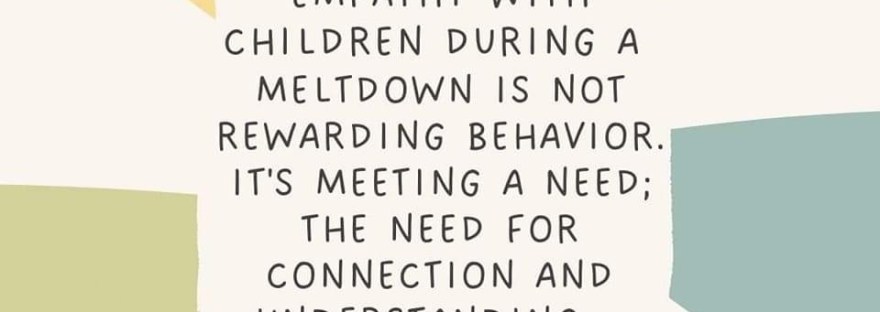
This is an example of restoration. This is a clear example of growth through coregulation over control. This example may be uncomfortable reading as you may have the automatic response or programming to think “no way, electronics are taken away and she should never talk to you like that!” I get it. Unlearning is NOT an easy process- it’s kind of like reprogramming an operating system that’s been functioning for 40 years. It’s not easy and unfortunately, it takes practice and experiences to experience the impact of slowing down to connect and not control, yet each time you try- you’ll feel the value of your efforts.

In conclusion, I know my parents were incredibly impactful in my childhood. They did their best to provide me opportunities to thrive and make a positive impact on the world around me. I don’t have any discipline traumas to speak of because I felt my actions were coupled with appropriate discipline response. Yet now being a parent myself and after powerful conversations and reflections with my parents, it’s been beautiful to discuss how parenting has been so different for me as it was for them. Therefore, I encourage you to reflect on how you’re building resiliency in the youth that you lead. Are you responding or are you reacting? If my reaction was bigger than I/they liked, how can I reconnect for restoration? Am I aware of the nuances of the needs of my child? How am I managing my emotions and how am I modeling emotional response?

To wrap this up, please remember, parenting is a process and the more you can reflect on the progress, you will continue to make great impact. Each child (and human) are designed beautifully different and each generation has varying social and emotional influences, thus we need to continue to commit to being responsive (not reactive), compassionate (not controlling) in order to build resiliency in this new generation.

woman holding brown paper cup
Reflections

Bandwidth: Capacity to Contribute

I’m drained. I’m done. I am empty.

These are words you say when you are physically, emotionally or socially exhausted. You have limited capacity to contribute.

I’ve said this myself and have most definitely have heard it amongst my peers. Overwhelm. Fatigue. Burnout. The reality of servant leadership is when you spend your energy caring for others, it often leads to physical, emotional or mental fatigue. The degree upon which you feel this fatigue is based on frequency and duration of the support you provide as well as receive. Therefore, its incredibly important to stay connected with others and honest in our self-reflection of our well-being.

With this, I was having a great conversation with a great friend and mentor of mine. When we were debriefing about the heightened stress in teachers and students, she re-explained the “flipped lid” theory from Daniel Siegel. Let me explain this reimagined model.

Using the “hand model,” of the brain, imagine this:

  • Make a fist with your hand by putting your thumb in your palm and closing your fingers over your thumb
  • Move your fingers up in the fist so your fingers are only bent at second knuckle (barely covering your thumb but still a closed fist)

This now represents a modified “hand model” of the brain where the amygdala (represented by the thumb) is more exposed and less protected by our cortex (represented by our fingers).

When your stress response is active, similar to the modified ‘hand model,’ it doesn’t take much stimulus for your stress response to activate. A pencil drop, an unexpected sound or situation, your nervous system goes into fight, flight or freeze automated response.

With this, I want you to notice something.. do you find yourself ‘managing’ your ‘bandwidth’ until it’s fried or burnt out? A lot of us do. And this ‘bandwidth management’ is clearly or invisibly impacting our health and relationships. And this is why it is so incredibly important for you to understand our nervous system so you can be more attune to body signals when managing your ‘bandwidth.’

Let’s be honest. We’ve been recovering from collective community trauma (aka world pandemic and more), so our ‘bandwidth’ has been constricted and our stress response system has been highly active. Therefore, your nervous system has been in overdrive on a daily basis. Again, another reason why it’s important for you to understand healthy ways to manage your bandwidth.

So, what should you do? How can you balance your daily energy withdrawls?

Let me provide some short and sweet suggestions (as time is a deposit AND a withdrawl):

  1. Sensation Self -Check: Are you feeling tense? Are you feeling tired? Are you feeling cold? These body signals are indicators that your nervous system is actively managing your stress and is signaling a slow down for your mind and body. You don’t need to do anything drastic to pause- simply stop and reconnect with your body through breath and grounding techniques.
  2. Name it to Tame it: No need to go tell someone, but if you have a safe person- you can go to them to share your ‘bandwidth’ support need. Yet, you can also use self-talk and tell yourself to pause and tell yourself “my bandwidth needs some support, so I could… (insert strategy here).”
  3. Distract your energy with a low-level or engaging task: Turn on music, go to the bathroom, tidy up your desk, go for a mini-walk. Something that takes little to no cognitive energy. This will give you a mini boost to your bandwidth. When you can take 90 seconds- 2 minutes to shift and settle your energy use, it provides you enough endorphins to reset and return to the more demanding tasks of your day.

When you take care of your emotional, cognitive and relational energy, you will find yourself responding more effectively in stressful situations. You’re working from the reasoning part of your brain (cortex) rather than your fight or flight (amygdala) part of your brain.

With this, I want to encourage you to not feel the pressure of having to do a lifestyle change in order to restore your bandwidth. It truly is a mini-moment investment and awareness of restorative experiences. Taking the two minutes to disconnect from a stressful circumstance can empower you far more than you expect. You manage stress to varying levels throughout your day. May you find the moments to restore your bandwidth to build your capacity to do all of the great things you can do!

woman holding brown paper cup
Photo by Maria Tyutina on Pexels.com
Reflections

Checking Your “Engine” Meditation Moment

As we are here together and you are actively listening to what I am sharing, I want you to settle in where you are. Try to find your body’s rest point and fall into that space. Once you’ve found your comfortable position, take a slow breath in through your nose, feeling your body melt into the position you are anchored at, and release a slow, steady exhale out.

Today we are going to explore our internal engine. We are going to check it’s rpm’s and how our engine is running. As you are listening, put your right hand onto your chest. Take a moment to connect to your “engine” that’s running. Is the motor “purring” or in idle? Is it revving it’s engine, ready to move forward to the next thing? Or is it steady on a cruise? You can check it’s status by the rate of your heart (beating fast, slow, steady) and the depth of your breath (shallow, deeper).

As you connect with your engine, let’s also attune to the other parts of our vehicle. Let’s bring our attention to our feet. Do you sense tension or grounding in your toes? Do you feel like you have good “traction?” If not, give your toes a squeeze and release or rotate your ankle to check in with the “pressure” within your foot to empower your toes.

Next let’s go upward to your navigation station (your head). At this moment, let’s place your hand back into a comfortable position. Let’s then close our eyes (if you’re comfortable) and do a small head rotation in whichever direction your body leads you. Let’s do two rotations, slow and steady. As you do so, pay attention to your breath. Are you holding your breath or are you still able to control your breathing pace? If you need to take a cleansing breath, please do so now.

As you continue to listen, let’s discuss how your navigation station is impacting your engines pace and readiness. First, your breathing is the key power to the capacity of your vehicle. You breathe in the air to empower and release the toxins when nutrients are absorbed as needed to safely pace the engine. If you breathe in too hard, too fast, sometimes the engines stalls. If you don’t breathe in and out deep enough, the engine will need to be serviced sooner than if you focused on taking in deep breaths as the engine is always going.

As we wrap this up, I invite you to take a steady breath in, feeling your engine with your hand on your chest, and as you slowly exhale, wiggle your toes and rotate your head slowly so you navigation station and traction is set for a safe pace to your day. Thank you for checking your engine and getting ready for a great opportunity for smooth cruising.

Inspired by article: https://insight-international.org/amygdala-hijack-getting-back-into-the-drivers-seat

Sensory Processing

What is “masking?”

I recently did a podcast on masking but I can’t get it out of my head! Now that the concept is so fresh and real to me- I feel like I’m seeing it everywhere!

Listen to my podcast episode here:

Why do we need to feel like we need to hide from our true selves? What makes it challenging for us to be vulnerable and real? Unleashing your real-ness takes vulnerability and courage, yet why? Peeling the layers away from what you’ve hidden from is freeing, yet it’s also incredibly difficult in a society shaped by “norms.”

I understand the law and order idea to this too. Yes, having expectations is valuable most of the time, yet WHAT expectations and how they are enforced is what should be explored.

Now, let me revisit the term “masking.” The Neurodiversity Association defines “Masking” as concealing neurodiverse traits in order to fit in. (What is neurodiversity? – Neurodiversity Association) With this definition alone, it demonstrates the ‘conformity’ behind the idea.

I validate the real-ness behind ‘masking’ for our neurodiverse children and adults, yet are the neurotypical humans creating this need to mask? Exploring this potential is powerful. How can our neurotypicals (who may not empathetically understand the neurological challenges of others) be more comfortable with differences? We need to build experience and understanding to be more inclusive in conversations and experiences. Honest and true- we have more in common than you may think!

So let’s go there. We all hide from something. We all try to make others comfortable and hide our struggles. I mean- think of a world where we could embrace our honest nervous system navigation. We’d support each other and be more comfortable with what we’d be going through and recognize that though we may be different- we’d still be valued as an INDIVIDUAL.

Let’s think about the different ways human beings “mask.” Then we will explore how neurodiverse minds are challenged by masking.

First, I think of our Black Lives Matter movement right now. They’ve been challenged with the social masking due to systemic inequities throughout our history. This impacts their behavior (heightened stress response), trust (in leadership and systems) and everyday interactions. I strongly believe that putting the intergenerational trauma of racism on the table is important for UNIFICATION. Let’s be real. Systemic change is needed. Equity should begin to be the norm. Taking this mask off takes vulnerability for ALL races. Yet- it’s possible. Let’s have a conversation to lead to correction and direction.

Next- I think of our soldiers who return from war. We do not have a well-designed system or reintegration into society. They have gone through radical nervous system training for survival and then to come back to the ‘free society’ and have to rewire their nervous system without support creates masking behaviors. By not recognizing the impact that soldiers experience when they return from combat is encouraging unhealthy masking behavior. Let’s effectively (and quickly) create systems of support for our honorable Veterans. PTSD is more prevalent than identified. Let’s support their nervous system healing.

american flag under a cloudy sky
Photo by Karolina Grabowska on Pexels.com

Lastly, lets explore how neurodiverse minds have ‘masked’ their neurodiverse traits around neurotypically designed systems and expectations. Essentially, we all have a nervous system activated looking for cues of safety and danger. We are unconsciously scanning our environment seeking predictability and comfort. When our nervous system sends signals to our brain to react and respond to what our senses are processing, it creates our behavior and engages our level of response. Do we flock, freeze, fight or flee when we signal a behavior that’s uncomfortable or unfamiliar? Truth be told- your physiological response (body reaction) oftentimes creates the discomfort that creates masking behavior in neurodiverse individuals. That, and… potentially your language, tone and interaction as well. Oftentimes, unintentionally.

Therefore, I give you a small challenge that’ll reap widespread reward. Be aware and attune to your nervous system response (body and mind connection) when experiencing an uncomfortable behavior in yourself and others. When doing this, you may realize that you may be demonstrating ‘masking’ behavior and/or encouraging others to ‘mask’ theirs.

Again, it all comes down to creating unification amongst our differences. By no means should we be divided because of our discomfort. Let’s seek to understand. Let’s accept one another when going through something not-so-easy. Let’s build inclusive systems and expectations. Let’s empower Sensational Synergy by seeking to understand ourselves and each other better.

Here is a well-written article about Autism Masking. Read this for understanding, yet explore how these behaviors can apply to all neuro-profiles. Understanding-Autism-Masking-and-Its-Consequences.pdf (lifestreaminc.com)